
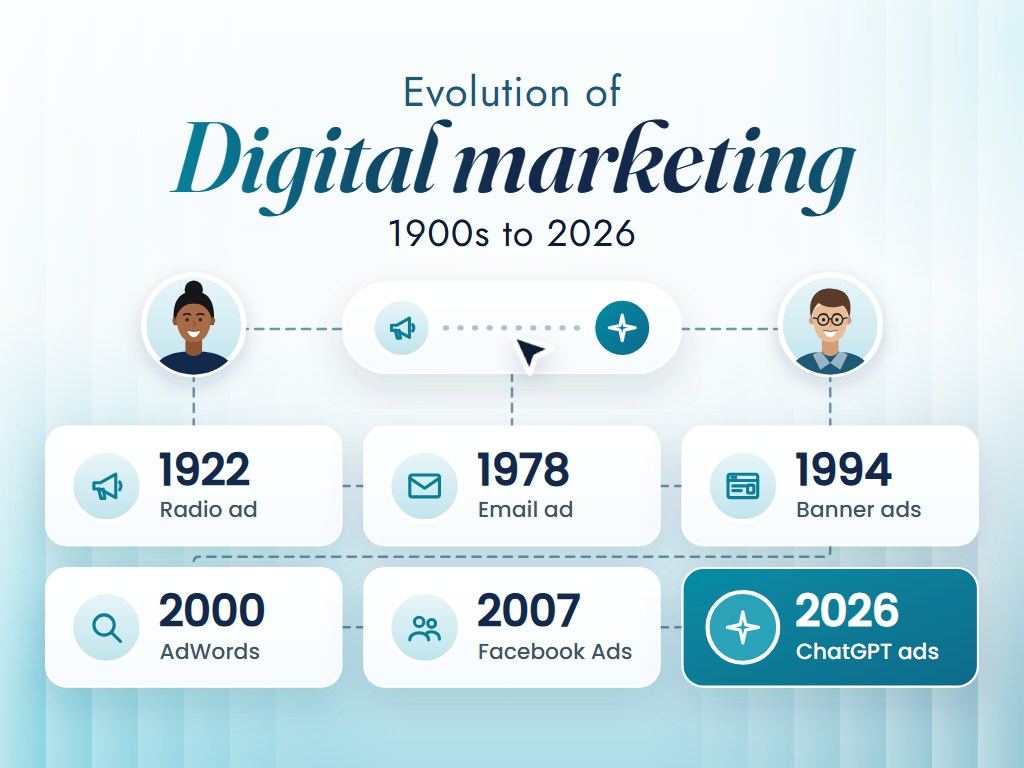
How did digital marketing evolve?
The evolution of digital marketing runs from print, radio and television in the 1900s, through email, websites, search, social media and mobile, to AI assistants that answer buyers directly in 2026. Digital channels only appeared in the 1970s, but the ideas behind them are older.
Each stage added a new way to reach people and a new way to measure the result. Few of the old ones disappeared, which is why a modern marketing plan has so many parts.
Key takeaways
- Measured advertising came before computers. Coupon testing was described in a book in 1923.
- Commercial email dates from 1978, the first web banners from 1994 and Google’s ad platform from 2000.
- Advertisers moved from paying for airtime to paying for views, then clicks, then results.
- In India, digital grew from 12% of ad spend in 2016 to 59% in 2025, according to dentsu.
- In 2026, ads reached AI assistants in India, including ChatGPT and Google’s AI Mode.
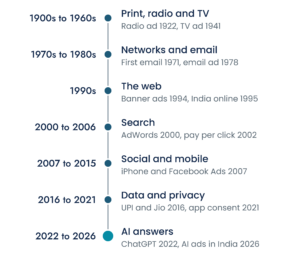
Figure 1. Seven eras in the evolution of digital marketing.
1900s to 1960s: the roots of digital marketing
Digital marketing did not exist in this period. Its habits did.
In 1923 Claude Hopkins published Scientific Advertising, which described testing one advert against another and using coupons to count the replies. A modern A/B test follows the same logic.
Broadcast then changed the scale. On 28 August 1922 a New York property company paid $50 for ten minutes on radio station WEAF, widely treated as the first paid radio commercial. On 1 July 1941 Bulova paid $9 for the first commercial on licensed American television.
Reach was huge and feedback was slow. A brand spoke once and waited for sales.
1970s and 1980s: networks and the first email
In 1971 Ray Tomlinson built the first email system that worked between computers. Seven years later, on 3 May 1978, Gary Thuerk of Digital Equipment Corporation emailed ARPANET users to promote a new computer. The reaction was swift and negative.
That message is often called the first spam. It taught a lesson that still applies: being able to reach someone does not mean they agreed to hear from you.
1990s: the web and the first banner ads
CERN released the World Wide Web on its own central machines in May 1991. On 30 April 1993 it declared the technology free for anyone to use, and commercial websites followed.
On 27 October 1994 the online magazine HotWired launched with banner ads from 12 brands, including AT&T and Volvo. For the first time, a reader could go from an advert to the advertiser in one click.
India joined soon after. VSNL opened public internet access on 15 August 1995, starting in a few large cities over dial-up.
2000 to 2006: search and measurement
Google launched AdWords on 23 October 2000, after about 350 businesses and agencies had used its test version. At first advertisers paid for views. On 20 February 2002 Google introduced cost-per-click pricing, so they paid only when someone clicked.
Google Analytics arrived in November 2005. A small business could now see which page, keyword or campaign brought each visitor. Search engine optimisation grew into a discipline alongside it.
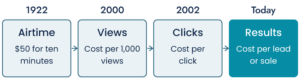
Figure 2. What advertisers pay for. Sources: Saturday Evening Post; Google press releases.
2007 to 2015: social media and mobile
Two events in 2007 set the direction. Apple announced the iPhone on 9 January, and Facebook Ads launched on 6 November with business pages, social ads and audience insights.
Marketing became a conversation. Customers could reply, review and share, and brands had to answer. On 1 November 2013 Michael Kors ran the first ad on Instagram, and the feed became a shop window.
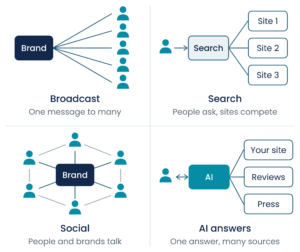
Figure 3. Four ways brands and buyers have communicated.
2016 to 2021: mobile India, data and privacy
India goes mobile
UPI began as a pilot on 11 April 2016, and Jio started commercial 4G service on 5 September 2016. Data and payments moved to the phone together. By 2025 India had about 958 million active internet users.
Google followed the users. In March 2018 it began mobile-first indexing, which uses the phone version of a page for indexing and ranking.
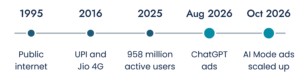
Figure 4. Milestones for digital marketing in India. Spacing is not to scale.
Privacy changes the data
Tracking grew until platforms and lawmakers limited it. Safari has blocked third-party cookies by default since 2020. From 26 April 2021 Apple required apps to ask permission before tracking people. Data given with consent became more valuable than data collected quietly.
2022 to 2026: AI answers the question
ChatGPT was released on 30 November 2022. In May 2024 Google started showing AI Overviews to everyone in the United States, with more countries to follow. Buyers began to get a full answer before visiting any website.
Advertising followed the attention again. OpenAI began testing labelled ads in ChatGPT in the US on 9 February 2026 and brought them to India on 27 August. On 28 October Google said it was scaling ads in AI Mode in ten countries, India among them.
The question for a brand has changed from “Do we rank?” to “Are we part of the answer?” Our guide to AI visibility, SEO, AEO and GEO explains how to work on that.
How far has digital advertising grown in India?
According to dentsu’s 2026 report, digital rose from 12% of Indian ad spend in 2016 to 59% in 2025. Television held 21% and print 14%. Dentsu expects digital to reach 70% in 2027. The 2024 figure was 49%.
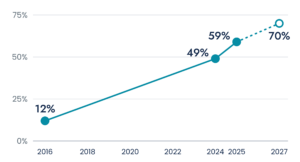
Figure 5. Digital share of advertising spend in India. Dots mark reported years; 2027 is a projection. Source: dentsu.
Estimates differ by method. WPP Media puts digital at 68.1% of 2026 ad revenue, but it also counts the digital versions of TV, print and other media.
Digital marketing then and now
|
Era |
Main channel |
What was measured |
What buyers did |
|
1900s to 1960s |
Print, radio, TV |
Coupons, sales |
Listened |
|
1970s to 1980s |
Email on networks |
Replies |
Received |
|
1990s |
Websites, banners |
Visits, clicks |
Browsed |
|
2000 to 2006 |
Search |
Cost per click |
Searched |
|
2007 to 2015 |
Social, mobile |
Engagement, leads |
Shared |
|
2016 to 2021 |
Mobile, data |
Sales, consent |
Bought by phone |
|
2022 to 2026 |
AI assistants |
Mentions, qualified leads |
Asked |
What stayed the same
Each era added a skill and kept the earlier ones.
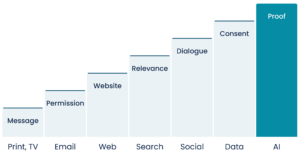
Figure 6. The skill each era added.
Four things have held for a century:
- A clear message wins. A ten-minute radio talk and a six-second video both need one point.
- Testing beats opinion. Hopkins counted coupons. You can count qualified leads.
- Permission matters. The 1978 email and today’s consent rules make the same case.
- Trust takes time. Buyers check you in more places now, so your brand has to match everywhere. See branding for AI-era B2B buyers.
How to prepare for the next stage: a 90-day plan
- Days 1 to 15: check your foundations. Test your site on a phone, fix slow pages and confirm that tracking works.
- Days 16 to 30: check your answers. Ask ChatGPT, Gemini and Google the questions your buyers ask. Note who is mentioned and which sources are used.
- Days 31 to 60: publish proof. Write clear answers, add real results and name the people behind them.
- Days 61 to 75: clean your data. Record consent, remove duplicates and connect leads to sales.
- Days 76 to 90: run one test. Try two different ad ideas on one channel, then keep the one that brings better leads.
If the website is the weak point, start with web strategy in 2026.
What to measure
- Qualified leads and sales by channel
- Cost per qualified lead, compared with last quarter
- Mentions in AI answers for your ten most important questions
- Branded searches: how often people look for you by name
- Consent rate on your forms
FAQs
When did digital marketing start?
There is no single date. Commercial email dates from 1978, and the first web banner ads ran on HotWired on 27 October 1994. Most of what we now call digital marketing grew from the web in the 1990s.
Was there digital marketing in the 1900s?
Yes, but only late in the century. The early 1900s gave marketing its testing methods and mass media. Networked email arrived in 1971 and the public web in the 1990s.
What are the main stages in the evolution of digital marketing?
Seven stages cover it: print, radio and TV, then networks and email, the web, search, social and mobile, data and privacy, and AI answers. Each stage added to the last.
When did digital marketing start in India?
Public internet access began on 15 August 1995 through VSNL. Growth sped up after 2016, when UPI and Jio’s 4G service launched.
Will AI replace digital marketing?
AI is changing how buyers find information and how ads are bought. Businesses still need a clear offer, trusted proof, a good website and people who check the work.
How Pixtornet can help with digital marketing
Pixtornet is a design and digital studio with teams in Chennai and Bangalore. We bring the pieces from every era together:
- Digital marketing: search, social and paid campaigns tied to leads and revenue
- Website design and development: fast, mobile-ready sites that search engines and AI tools can read
- Branding: one clear message wherever buyers check you
- Video production: films and short cuts for site, social and sales
Ready for the next stage? Book a free consultation.