
Is AI taking over digital marketing?
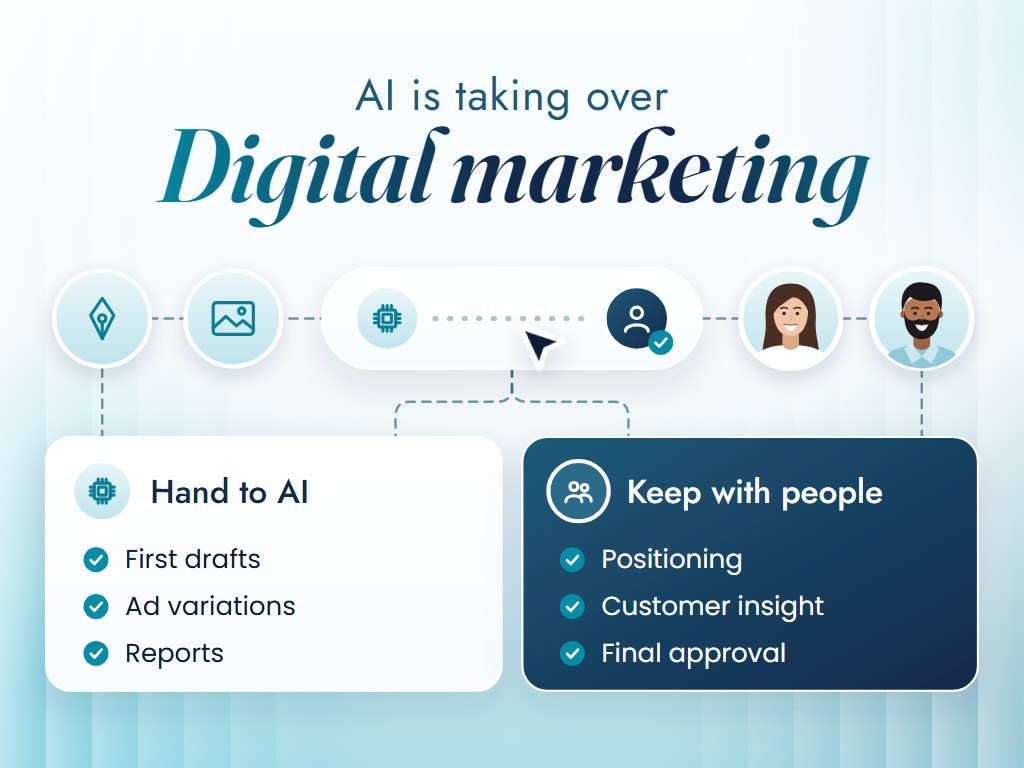
AI is taking over many of its tasks, including search answers, ad targeting, bidding and first drafts. Strategy, customer insight, creative direction and accountability still need people. The businesses that gain most in 2027 will be clear about which is which.
The budgets tell a more interesting story. In Gartner’s 2026 CMO Spend Survey, marketing leaders put an average of 15.3% of their budgets into AI. In the same survey, the share spent on people rose from 21.9% to 24.5%.
So AI is taking over tasks, while people cost more of the budget than they did a year ago. If you run a business, the useful question is which tasks to hand over, and which to protect.
Key takeaways
- Most marketing teams use AI, but very few have built it fully into their work.
- AI Overviews cut clicks to outside websites by 38% in a controlled US study, so being named in the answer matters more.
- Customers trust brands less when they see too much AI content.
- India’s new ASCI guidelines will require labels on some AI-generated ads.
- Start with clean lead data, automate two workflows, then invest in proof AI can’t copy.
How far has AI taken over digital marketing?
Most teams use AI. Very few have built their work around it.
- Use is close to universal. Jasper’s 2026 survey found 91% of marketing teams use AI, up from 63% in 2025.
- Deep adoption is rare. Supermetrics surveyed 435 marketers in five countries and found only 6% had AI fully built into their workflows.
- Readiness lags ambition. In Gartner’s survey, 70% of marketing leaders called AI a key goal for 2026. Only 30% felt they had the infrastructure to reach it.
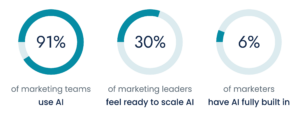
Figure 1. AI use compared with AI readiness in 2026. Three separate surveys, so the groups differ. Sources: Jasper, Gartner, Supermetrics.
Neither the Supermetrics nor the Gartner sample includes India, and Gartner’s respondents are mainly at companies with over $1 billion in revenue. The pattern should still sound familiar: plenty of tools, not much of a system.
Where AI in digital marketing already runs the work
1. AI search: the answer comes before the click
Google’s AI Overviews now answer many questions on the results page. In a randomised study of 1,065 US desktop users, AI Overviews cut clicks to outside websites by 38% on the searches where they appeared. Searches ending without any click rose from 54% to 72%. The paper has not been peer-reviewed yet, but it is a controlled experiment rather than a before-and-after comparison.
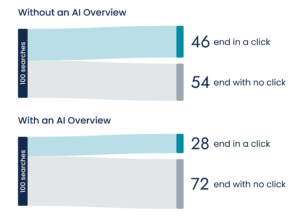
Figure 2. What happens to 100 searches that trigger an AI Overview, with the Overview hidden and shown. Source: Agarwal and Sen (2026 working paper), via Search Engine Journal.
One detail is easy to miss: clicks on sponsored results held steady.
Getting visitors from search is harder, so being named in the answer matters more. Google’s own guidance is refreshingly plain. Publish original material based on what you know, make sure the page can be indexed, and skip the special AI files, because llms.txt neither helps nor harms your Google rankings.
We covered this in detail in Getting Into the Answer: AI Visibility for B2B Leaders.
2. AI advertising: you set the goal, the platform does the rest
Google has extended AI Max beyond search into shopping and travel. Advertisers can now describe messaging and audience limits in ordinary language, and AI picks the landing page for each query. Meta’s Advantage+ already automates much of campaign set-up, and the stated direction is whole campaigns assembled from a product link, images and basic brand details.
There is a new channel too. OpenAI began showing ads in ChatGPT in India in late August 2026, to adults on the Free and Go plans.
When every advertiser has the same automation, the differences come from what you feed it: your offer, your video and creative, your landing pages and your conversion data.
3. AI content: the cost of a first draft has collapsed
Blog drafts, ad variations, captions, translations and video cut-downs now take minutes. That speed is available to your competitors as well, so volume alone buys very little.
It can also hurt. Google says generating many pages without adding value for users may break its spam policy on scaled content abuse. It also reminds publishers that these models predict likely words and do not retrieve facts, so every claim needs checking.
Where the AI takeover stalls: customer trust
Customers have noticed, and buyers check what AI tells them. Our article on brand consistency for AI-era buyers explains why that check matters.
Gartner surveyed 1,006 US consumers in May and June 2026. 65% said brands put too much AI-generated content in their marketing, and 57% said it had made them less trusting of brand messaging. In the UK, Optimizely found 62% trust marketing content less since brands began using AI, while 72% were more likely to engage with content that feels human.
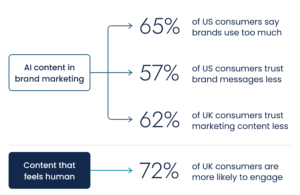
Figure 3. How consumers respond to AI content and to content that feels human. Sources: Gartner (US), Optimizely (UK).
AI ad labelling in India: the new ASCI rules
India is adding rules. The Advertising Standards Council of India released guidelines on AI-generated ad content on 29 September 2026, taking effect three months after publication. Labels become mandatory where AI content materially influences a buying decision and leaving the label out could mislead. Examples include AI-generated influencers and demonstrations of products that do not exist yet. Routine photo editing, AI-written ad copy and subtitles need no label. A label will not rescue an ad that misleads.
ASCI is a self-regulatory body and its code is separate from the law. The government’s own IT rules on synthetic content have applied since February 2026.
What to hand to AI and what to keep human
Hand to AI | Keep with people |
First drafts, outlines and summaries | Positioning and the final message |
Ad variations, bidding and placement | Offer, budget limits and brand rules |
Keyword grouping and call transcripts | Customer interviews and sales insight |
Resizing, captions and translations | Visual identity and creative direction |
Pulling reports and spotting changes | Deciding what to do about them |
Routine follow-up emails | Sensitive replies and key relationships |
A simple test: if a mistake would be cheap and easy to spot, automate it. If it would cost you a customer’s trust, put a named person in charge.
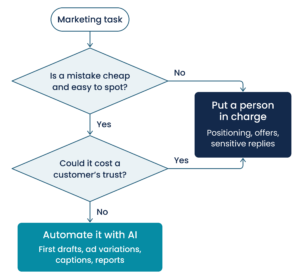
Figure 4. A two-question test for deciding what to automate.
A 90-day plan for using AI in digital marketing
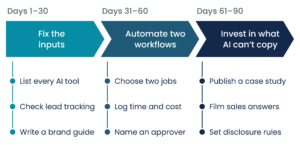
Figure 5. A 90-day plan for using AI in digital marketing.
1. Days 1–30: fix the inputs
- List every AI tool your team uses, including the unofficial ones.
- Check that your website forms, CRM and ad accounts record real leads. Automated bidding learns from this data.
- Write a two-page brand guide: who you serve, what you claim, words you use, words you avoid.
2. Days 31–60: automate two workflows
- Choose two repetitive jobs, such as monthly reporting and ad variations.
- Record the time and cost of each before you begin.
- Name one person who approves everything that goes out.
3. Days 61–90: invest in what AI can’t copy
- Publish one case study with real numbers and a named client.
- Film a founder or engineer answering the five questions your sales team hears most. Plan one shoot for many cuts.
- Agree your AI disclosure rules before the new ASCI guidelines apply.
What to measure
- Qualified leads and cost per qualified lead, agreed with sales
- Hours saved per workflow, after review time
- AI visibility: Search Console’s Generative AI performance report, plus a monthly check of what ChatGPT and Gemini say about you
- Branded searches, as a sign that people are asking for you by name
- Error rate: how often a reviewer has to correct AI output
If output is rising and qualified leads are flat, AI is only helping you produce more noise. For where the money should go, see our guide to planning a 2027 B2B marketing budget.
FAQs
Will AI replace digital marketers?
AI is replacing tasks faster than whole roles. Drafting, resizing, bidding and reporting are increasingly automated. Strategy, customer understanding, creative direction and accountability still need people, and Gartner’s 2026 survey shows the labour share of marketing budgets rising.
Is AI-generated content bad for SEO?
Using AI does not break Google’s rules by itself. The risk comes from publishing many pages that add no value, which may violate its spam policy. Add first-hand experience, check every fact and have a person approve the final version.
Do I need to label AI-generated ads in India?
Under ASCI’s 2026 guidelines, labels are required when AI-generated content materially influences a purchase and its absence could mislead. Routine editing, AI-written ad copy and subtitles are exempt. Check the full guidelines or take legal advice for your own campaign.
Which digital marketing tasks should stay human?
Keep positioning, final messaging, offers, customer interviews, creative direction and sensitive replies with people. Use one test: if a mistake would cost a customer’s trust, a named person should own the task.
How should a small business start with AI in digital marketing?
Begin with clean lead tracking and one repetitive task. Measure the time it takes today, automate it, and keep a person reviewing the output. Expand once you can show that it saves time or brings in better leads.
How Pixtornet helps you use AI and keep your brand
Every competitor can rent the same AI tools. Your customer knowledge, your proof and your point of view belong to you, and they decide how well those tools perform.
Pixtornet is a design and digital studio with teams in Chennai and Bangalore. We bring strategy, design and build under one roof:
- Digital marketing services: SEO, AEO and GEO to get you found on Google and in AI answers, plus ads, social and email, reported monthly
- Website design and development: fast, SEO-ready websites
- Branding: strategy, identity and brand guidelines
- Corporate video: brand films, explainers and customer testimonials
Want to know what to automate and what to protect in your own marketing? Book a free consultation.